Sunday, May 5, 2013
Berkenalan dengan Mary Wollstonecraft sang pencipta Frankenstein
Sebagai seorang penulis wanita yang orang bertanya-tanya bagaimana seorang anak perempuan sampai bisa berpikir menulis cerita yang begitu misterius dan menakutkan

Case studies: A hard look at GM crops
Superweeds? Suicides? Stealthy genes? The true, the false and the still unknown about transgenic crops.

Palmer amaranth has taken root as a herbicide-resistant ‘superweed’ in many US cotton fields.
Polaris/eyevine
Researchers, farmers, activists and GM seed companies all stridently promote their views, but the scientific data are often inconclusive or contradictory. Complicated truths have long been obscured by the fierce rhetoric. “I find it frustrating that the debate has not moved on,” says Dominic Glover, an agricultural socioeconomist at Wageningen University and Research Centre in the Netherlands. “The two sides speak different languages and have different opinions on what evidence and issues matter,” he says.

Here, Nature takes a look at three pressing questions: are GM crops fuelling the rise of herbicide-resistant ‘superweeds’? Are they driving farmers in India to suicide? And are the foreign transgenes in GM crops spreading into other plants? These controversial case studies show how blame shifts, myths are spread and cultural insensitivities can inflame debate.
GM crops have bred superweeds: True
Jay Holder, a farming consultant in Ashburn, Georgia, first noticed Palmer amaranth (Amaranthus palmeri) in a client’s transgenic cotton fields about five years ago. Palmer amaranth is a particular pain for farmers in the southeastern United States, where it outcompetes cotton for moisture, light and soil nutrients and can quickly take over fields.Free podcast
Case studies reveal the complex truths behind GM crop myths.Some scientists and anti-GM groups warned that GM crops, by encouraging liberal use of glyphosate, were spurring the evolution of herbicide resistance in many weeds. Twenty-four glyphosate-resistant weed species have been identified since Roundup-tolerant crops were introduced in 1996. But herbicide resistance is a problem for farmers regardless of whether they plant GM crops. Some 64 weed species are resistant to the herbicide atrazine, for example, and no crops have been genetically modified to withstand it (see ‘The rise of superweeds’).
Still, glyphosate-tolerant plants could be considered victims of their own success. Farmers had historically used multiple herbicides, which slowed the development of resistance. They also controlled weeds through ploughing and tilling — practices that deplete topsoil and release carbon dioxide, but do not encourage resistance. The GM crops allowed growers to rely almost entirely on glyphosate, which is less toxic than many other chemicals and kills a broad range of weeds without ploughing. Farmers planted them year after year without rotating crop types or varying chemicals to deter resistance.

Source: Ian Heap, International Survey of Herbicide Resistant Weeds www.weedscience.org/graphs/soagraph.aspx (2013).
Glyphosate-resistant weeds have now been found in 18 countries worldwide, with significant impacts in Brazil, Australia, Argentina and Paraguay, says Ian Heap, director of the International Survey of Herbicide Resistant Weeds, based in Corvallis, Oregon. And Monsanto has changed its stance on glyphosate use, now recommending that farmers use a mix of chemical products and ploughing. But the company stops short of acknowledging a role in creating the problem. “Over-confidence in the system combined with economic drivers led to reduced diversity in herbicide use,” Cole tells Nature.
On balance, herbicide-resistant GM crops are less damaging to the environment than conventional crops grown at industrial scale. A study by PG Economics, a consulting firm in Dorchester, UK, found that the introduction of herbicide-tolerant cotton saved 15.5 million kilograms of herbicide between 1996 and 2011, a 6.1% reduction from what would have been used on conventional cotton2. And GM crop technology delivered an 8.9% improvement to the environmental impact quotient — a measure that considers factors such as pesticide toxicity to wildlife — says Graham Brookes, co-director of PG Economics and a co-author of the industry-funded study, which many scientists consider to be among the field’s most extensive and authoritative assessments of environmental impacts.
The question is how much longer those benefits will last. So far, farmers have dealt with the proliferation of resistant weeds by using more glyphosate, supplementing it with other herbicides and ploughing. A study by David Mortensen, a plant ecologist at Pennsylvania State University in University Park, predicts that total herbicide use in the United States will rise from around 1.5 kilograms per hectare in 2013 to more than 3.5 kilograms per hectare in 2025 as a direct result of GM crop use3.
To offer farmers new weed-control strategies, Monsanto and other biotechnology companies, such as Dow AgroSciences, based in Indianapolis, Indiana, are developing new herbicide-resistant crops that work with different chemicals, which they expect to commercialize within a few years.
Mortensen says that the new technologies will lose their effectiveness as well. But abandoning chemical herbicides completely is not a viable solution, says Jonathan Gressel, a weed scientist at the Weizmann Institute of Science in Rehovot, Israel. Using chemicals to control weeds is still more efficient than ploughing and tilling the soil, and is less environmentally damaging. “When farmers start to use more sustainable farming practices together with mixtures of herbicides they will have fewer problems,” he says.
GM cotton has driven farmers to suicide: False
During an interview in March, Vandana Shiva, an environmental and feminist activist from India, repeated an alarming statistic: “270,000 Indian farmers have committed suicide since Monsanto entered the Indian seed market,” she said. “It’s a genocide.”The claim, based on an increase in total suicide rates across the country in the late 1990s, has become an oft-repeated story of corporate exploitation since Monsanto began selling GM seed in India in 2002.

Source: Ref. 5
But, says Glover, “it is nonsense to attribute farmer suicides solely to Bt cotton”. Although financial hardship is a driving factor in suicide among Indian farmers, there has been essentially no change in the suicide rate for farmers since the introduction of Bt cotton.
That was shown by researchers at the International Food Policy Research Institute in Washington DC, who scoured government data, academic articles and media reports about Bt cotton and suicide in India. Their findings, published in 2008 (ref. 4) and updated in 2011 (ref. 5), show that the total number of suicides per year in the Indian population rose from just under 100,000 in 1997 to more than 120,000 in 2007. But the number of suicides among farmers hovered at around 20,000 per year over the same period.
And since its rocky beginnings, Bt cotton has benefited farmers, says Matin Qaim, an agricultural economist at Georg August University in Göttingen, Germany, who has been studying the social and financial impacts of Bt cotton in India for the past 10 years. In a study of 533 cotton-farming households in central and southern India, Qaim found that yields grew by 24% per acre between 2002 and 2008, owing to reduced losses from pest attacks6. Farmers’ profits rose by an average of 50% over the same period, owing mainly to yield gains (see ‘A steady rate of tragedy’). Given the profits, Qaim says, it is not surprising that more than 90% of the cotton now grown in India is transgenic.
Glenn Stone, an environmental anthropologist at Washington University in St Louis, says that the empirical evidence for yield increases with Bt cotton is lacking. He has conducted original field studies7 and analysed the research literature8 on Bt cotton yields in India, and says that most peer-reviewed studies reporting yield increases with Bt cotton have focused on short time periods, often in the early years after the technology came online. This, he says, introduced biases: farmers who adopted the technology first tended to be wealthier and more educated, and their farms were already producing higher-than-average yields of conventional cotton. They achieved high yields of Bt cotton partly because they lavished the expensive GM seeds with care and attention. The problem now is that there are hardly any conventional cotton farms left in India to compare GM yields and profits against, says Stone. Qaim agrees that many studies showing financial gains focus on short-term impacts, but his study, published in 2012, controlled for these biases and still found continued benefits.
Bt cotton did not cause suicide rates to spike, says Glover, but neither is it the sole reason for the yield improvements. “Blanket conclusions that the technology is a success or failure lack the right level of nuance,” he says. “It’s an evolving story in India, and we have not yet reached a definitive conclusion.”
Transgenes spread to wild crops in Mexico: Unknown
In 2000, some rural farmers in the mountains of Oaxaca, Mexico, wanted to gain organic certification for the maize (corn) they grew and sold in the hope of generating extra income. David Quist, then a microbial ecologist at the University of California, Berkeley, agreed to help in exchange for access to their lands for a research project. But Quist’s genetic analyses uncovered a surprise: the locally produced maize contained a segment of the DNA used to spur expression of transgenes in Monsanto’s glyphosate-tolerant and insect-resistant maize9.GM crops are not approved for commercial production in Mexico. So the transgenes probably came from GM crops imported from the United States for consumption and planted by local farmers who probably didn’t know that the seeds were transgenic. Quist speculated at the time that the local maize probably cross-bred with these GM varieties, thereby picking up the transgenic DNA.
When the discovery was published in Nature, a media and political circus descended on Oaxaca. Many vilified Monsanto for contaminating maize at its historic origin — a place where the crop was considered sacred. And Quist’s study came under fire for technical deficiencies, including problems with the methods used to detect the transgenes and the authors’ conclusion that transgenes can fragment and scatter throughout the genome10. Nature eventually withdrew support for the paper but stopped short of retracting it. “The evidence available is not sufficient to justify the publication of the original paper,” read an editorial footnote to a critique10 of the research published in 2002.
Since then, few rigorous studies of transgene flow into Mexican maize have been published, owing mainly to a dearth of research funding, and they show mixed results. In 2003–04, Allison Snow, a plant ecologist at Ohio State University in Columbus, sampled 870 plants taken from 125 fields in Oaxaca and found no transgenic sequences in maize seeds11.
But in 2009, a study12 led by Elena Alvarez-Buylla, a molecular ecologist at the National Autonomous University of Mexico in Mexico City, and Alma Piñeyro-Nelson, a plant molecular geneticist now at the University of California, Berkeley, found the same transgenes as Quist in three samples taken from 23 sites in Oaxaca in 2001, and in two samples taken from those sites in 2004. In another study, Alvarez-Buylla and her co-authors found evidence of transgenes in a small percentage of seeds from 1,765 households across Mexico13. Other studies conducted within local communities have found transgenes more consistently, but few have been published14.
Snow and Alvarez-Buylla agree that differences in sampling methods can lead to discrepancies in transgene detection. “We sampled different fields,” says Snow. “They found them but we didn’t.”
The scientific community remains split on whether transgenes have infiltrated maize populations in Mexico, even as the country grapples with whether to approve commercialization of Bt maize.
“It seems inevitable that there will be a movement of transgenes into local maize crops,” says Snow. “There is some proof that it is happening, but it is very difficult to say how common it is or what are the consequences.” Alvarez-Buylla argues that the spread of transgenes will harm the health of Mexican maize and change characteristics, such as a variety’s look and taste, that are important to rural farmers. Once the transgenes are present, it will be very difficult, if not impossible, to get rid of them, she says. Critics speculate that GM traits that accumulate in the genomes of local maize populations over time could eventually affect plant fitness by using up energy and resources or by disrupting metabolic processes, for example.
Snow says that there is no evidence so far for negative effects. And she expects that if the transgenes now in use drift to other plants, they will have neutral or beneficial effects on plant growth. In 2003, Snow and her colleagues showed that when Bt sunflowers (Helianthus annuus) were bred with their wild counterparts, transgenic offspring still required the same kind of close care as its cultivated parent but were less vulnerable to insects and produced more seeds than non-transgenic plants15. Few similar studies have been conducted, says Snow, because the companies that own the rights to the technology are generally unwilling to let academic researchers perform the experiments.
In Mexico, the story goes beyond potential environmental impacts. Kevin Pixley, a crop scientist and the director of the genetic resources programme at the International Maize and Wheat Improvement Centre in El Batan, Mexico, says that scientists arguing on behalf of GM technologies in the country have missed a crucial point. “Most of the scientific community doesn’t understand the depth of the emotional and cultural affiliation maize has for the Mexican population,” he says.
Tidy stories, in favour of or against GM crops, will always miss the bigger picture, which is nuanced, equivocal and undeniably messy. Transgenic crops will not solve all the agricultural challenges facing the developing or developed world, says Qaim: “It is not a silver bullet.” But vilification is not appropriate either. The truth is somewhere in the middle.
- Nature
- 497,
- 24–26
- ()
- doi:10.1038/497024a
Friday, May 3, 2013
New Advances and Contributions to Forestry Research (blog yang menawarkan banyak buku bagus gratis download)
New Advances and Contributions to Forestry Research
Edited by Andrew Akwasi Oteng-Amoako, ISBN 978-953-51-0529-9, Hard cover, 256 pages, Publisher: InTech, Chapters published April 27, 2012 under CC BY 3.0 license
DOI: 10.5772/2246
New Advances and Contributions to Forestry Research consists of
14 chapters divided into three sections and is authored by 48
researchers from 16 countries and all five continents. Section Whither
the Use of Forest Resources, authored by 16 researchers, describes
negative and positive practices in forestry. Forest is a complex habitat
for man, animals, insects and micro-organisms and their activities may
impact positively or negatively on the forest. This complex relationship
is explained in the section Forest and Organisms Interactions,
consisting of contributions made by six researchers. Development of tree
plantations has been man’s response to forest degradation and
deforestation caused by human, animals and natural disasters.
Plantations of beech, spruce, Eucalyptus and other species are described
in the last section, Amelioration of Dwindling Forest Resources Through
Plantation Development, a section consisting of five papers authored by
20 researchers. New Advances and Contributions to Forestry Research
will appeal to forest scientists, researchers and allied professionals.
It will be of interest to those who care about forest and who subscribe
to the adage that the last tree dies with the last man on our planet. I
recommend it to you; enjoy reading it, save the forest and save life!DOI: 10.5772/2246
- Chapter 1
Effects of Deforestation on Water Resources: Integrating Science and Community Perspectives in the Sondu-Miriu River Basin, Kenya
- Chapter 2
- Chapter 3
- Chapter 4
- Chapter 5
- Chapter 6
- Chapter 7
- Chapter 8
- Chapter 9
- Chapter 10
- Chapter 11
- Chapter 12
- Chapter 13
- Chapter 14
Thursday, May 2, 2013
AgroBio in Colombia reported on current research to produce cold tolerance in genetically modified (GM) eucalyptus trees
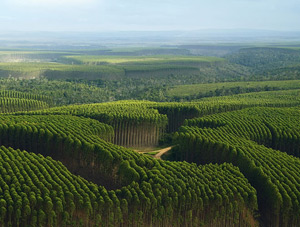 |
| Brazilian eucalyptus plantation photo courtesy of Big Lands Brazil |
Field testing indicates that GM eucalyptus trees can resist cold to -6°C (21°F). This will allow them to be planted in new regions where temperature drops to this level.
ArborGen has plans to grow more than 100,000 GM eucalyptus trees to be planted in 29 different locations in the United States. These plantings will provide the opportunity to study GM eucalyptus for agro-forestry purposes.
Other GM eucalyptus experiments are focused on creating trees that grow faster and have better quality wood. The goal is to make agro-forestry more efficient and sustainable.
The eucalyptus tree, eucalyptus camaldulensis dehn is native to Australia. Today, it is planted on 20 million hectares throughout the world. It can grow up to 25 meters in three years. Its wood is used in paper manufacturing and sometimes for fuel.
For more see: "Eucalipto genéticamente modificado resistente al frío," Agro-Bio (Colombia) Press Release, 16 February 2010. Sh
The Economic Times (of India) reports from New Delhi that the decision to place a moratorium on the commercial release of gene-modified (GM) BT brinjal (eggplant)

The Economic Times reports one of the cabinet ministers confided that the moratorium on BT brinjal "will not be an endless moratorium. This period will be used for thrashing out differences.” Agriculture Minister Sharad Pawar and Science and Technology Minister Prithviraj Chavan are in favor of immediately approving commercial release of the crop. Minister Ramesh is seeking more scientific tests and consultations with state governments.
Prime Minister Singh is reported as saying that biotechnology was an "important option for higher agricultural productivity and ensuring food security”. Yet he noted that the need to make certain that BT brinjal does not harm human and animal health or bio-diversity. The ministers all agree to set up a National Biotechnology Regulatory Authority to "inspire confidence and stimulate public and private investment in biotechnology." This would be separate from the GEAC, which is responsible for scientific issues.
For more see: "Ramesh Wins First Round, Brinjal In Chiller," Economic Times of India, 25 Feb. 2010. Sh
Indonesia Tissue Culture Network
Membaca beberapa artikel dan bahan seminar tentang bisnis dalam Tissue Culture.
Satu hal yang menarik adalah networking yang sangat penting dalam mengembangkan produk produk baru. Slogannya adalah : YOU HAVE THINGS THAT NO ONE ELSE HAVE IN THE WORLD.
Sekarang ini produk tissue culture seperti tanaman hias telah sangat berkembang. Produk baru yang merupakan hasil riset diuji ke pasar dan apabila pasar merespon dengan baik, maka produk tersebut akan diproduksi dalam jumlah yang besar. Nah, disini para sub kontraktor yang tersebar di berbagai negara akan memproduksi klon tersebut dan akan diekspor ke negara tujuan.
Beberapa perusahaan kultur jaringan di Indonesia.
http://www.monfori.com/16/services
Satu hal yang menarik adalah networking yang sangat penting dalam mengembangkan produk produk baru. Slogannya adalah : YOU HAVE THINGS THAT NO ONE ELSE HAVE IN THE WORLD.
Sekarang ini produk tissue culture seperti tanaman hias telah sangat berkembang. Produk baru yang merupakan hasil riset diuji ke pasar dan apabila pasar merespon dengan baik, maka produk tersebut akan diproduksi dalam jumlah yang besar. Nah, disini para sub kontraktor yang tersebar di berbagai negara akan memproduksi klon tersebut dan akan diekspor ke negara tujuan.
Beberapa perusahaan kultur jaringan di Indonesia.
http://www.monfori.com/16/services
SELAMAT HARI BURUH SEDUNIA ....MAY DAY....MAY DAY -----------Some Where, Some Time, Some Place......................Olive Schreiner
Ini adalah sebagian dari tulisan, yang temanya saya kutip dari Olive Schreiner. Temanya tentang perbudakan white over black.....sekalian juga "Selamat Hari Buruh Sedunia:
My heart was heavy; my physical heart seemed to have pain in it
as if small, sharp crystals were cutting into it.
All the world seemed wrong to me.
Why did every one press on every one and try to make them do what they wanted.
wHY DID THE STRONG ALWAYS CRUSH THE WEAK ?
Why did we hate and kill and torture ? Why was it all asit was ? Why had the world have ever been made ?
Why, oh Why, had I ever been born.
All the leaves and flowers and grasses on it turned bright gold, and the dew drops hanging from them were like diamonds; and the water in the stream glinted as it ran...........to be continiued
My heart was heavy; my physical heart seemed to have pain in it
as if small, sharp crystals were cutting into it.
All the world seemed wrong to me.
Why did every one press on every one and try to make them do what they wanted.
wHY DID THE STRONG ALWAYS CRUSH THE WEAK ?
Why did we hate and kill and torture ? Why was it all asit was ? Why had the world have ever been made ?
Why, oh Why, had I ever been born.
All the leaves and flowers and grasses on it turned bright gold, and the dew drops hanging from them were like diamonds; and the water in the stream glinted as it ran...........to be continiued
Subscribe to:
Posts (Atom)